
 Navigation
UmuC
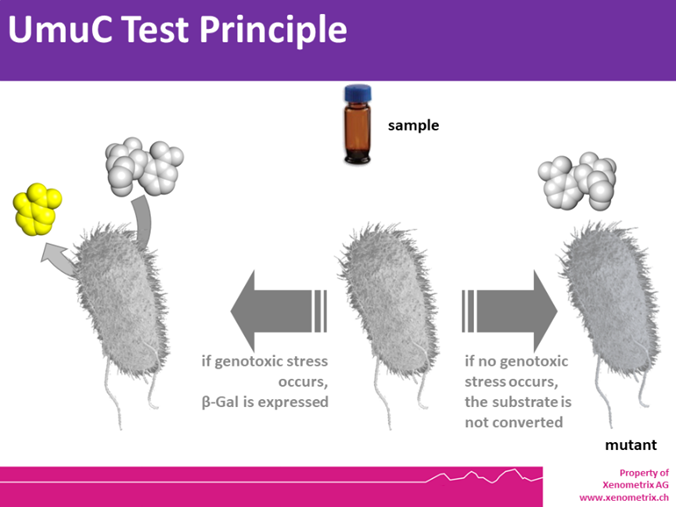
UmuC – Test Principle
The method was originally developed for environmental monitoring, in particular to detect genotoxicity of water and waste water.
The umuC Easy test kit is based on a genetically engineered Salmonella typhimurium TA1535 [pSK1002] which measures the SOS response of a cell to genetic damage. I The SOS regulatory system is maintained in the repressed state by the protein LexA. Upon DNA damage (due to radiation or chemicals), RecA is converted into a protease that activates the SOS system, which in turn activates a number DNA repair genes, including those of the umu operon. In just 16 hours, the kit provides a clear, quantitative measurement of the genotoxicity of a sample by simple colorimetric detection.
UmuC Tester Strain – Genotype
The tester strain is S. typhimurium TA1535 with the plasmid pSK1002, which carries a fused umuC’–‘lacZ gene . In this strain, lacZ is up-regulated as a result of the activation of the umu operon, allowing to monitor spectrophotometrically the β-galactosidase activity and hence the extent of DNA damage.
UmuC – Test Description
Salmonella typhimurium TA1535 [pSK1002] bacteria are exposed to potentially genotoxic test compounds. If genotoxic lesions are produced by the test compound, the umuC gene is induced as part of the bacterial SOS response. The induction of lacZ on the the plasmid pSK1002 is measured by the conversion of colorless ONPG substrate (o-nitrophenyl-β-D-galactopyranoside) to the yellow product o-nitrophenol by the lacZ-encoded β-galactosidase.
Since different kinds of genotoxic lesions lead to the induction of the SOS response, one strain of S. typhimurium with the appropriate reporter gene construct is sufficient to identify all classes of bacterial genotoxins. As with other bacterial genotoxicity and mutagenicity assays, compounds requiring metabolic activation for activity can be identified by the addition of S9 microsomal rat liver extract.
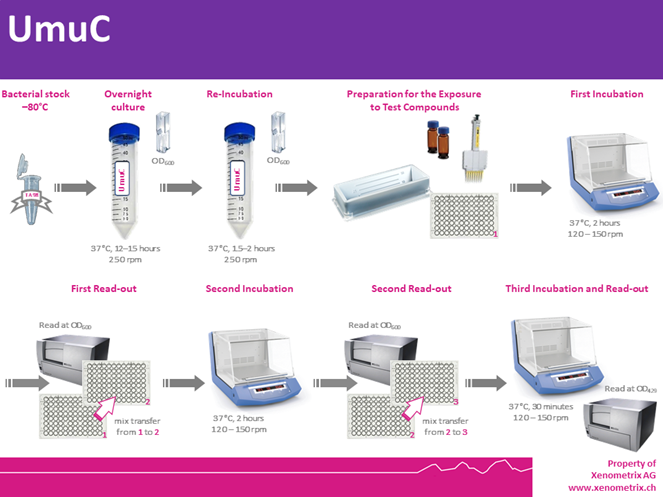
The protocol of the Xenometrix kit has been adapted from ISO 13829 "Water quality - Determination of the genotoxicity of water and waste water using the umu-test". All media and reagents except for the S9 co-factor concentrations are as described in ISO 13829 and can be used with the original ISO 13829 protocol or with this optimized umuC- Easy CS protocol. A formula allows to calculate β-galactosidase activity and percentage survival. A dose-dependent and significant increase in the expression of β-galactosidase over the background (associated with adequate survival) indicates that the sample led to DNA stress.
The mutagenic potential of samples is assessed directly and in the presence of metabolic activation, provided by a liver homogenate, a post-mitochondrial supernatant fraction S9, respectively, essentially in the same way as in the Ames test.
Ready-to-Use Kits or Individual Products?
Ready to use test kits including strain, media, ampicillin, S9, positive controls are available in the liquid microplate format UmuC Easy CS for the 96-well plates. The ready to use kits are quality controlled by phenotype of the strains, by positive controls as well as by rat liver microsomal fraction S9 and therefore are a more standardized system. Stability studies, growth control, toxicity studies of S9 and positive controls are continuously performed.
The products can also be used with an HPTLC (high-performance thin-layer chromatography) approach for an improved sensitivity and/or to allow subsequent biological or physical analyses.
Individual items of the UmuC Easy CS kit system are available as well.
UmuC – References
- Oda Y, Nakamura S, Oki I, Kato T, Shinagawa H. 1985. Evaluation of the new system (umu- test) for the detection of environmental mutagens and carginogens. Mut Res. 147(5):219–29.
- Nakamura S, Oda Y, Shimada T, Oki I, Sugimoto K. 1987. SOS-inducing activity of chemical carcinogens and mutagens in Salmonella typhimurium TA1535/pSK1002: Examination with 151 chemicals. Mut Res. 192(4):239–46.
- Reifferscheid G, Heil J, Oda Y, Zahn RK. 1991. A microtitre version of the SOS/umu-test for rapid detection of genotoxins and genotoxic potentials of environmental samples. Mut Res. 253(3):215–22.
- Reifferscheid G, Heil J. 1996. Validation of the SOS/umu test using test results of 486 chemicals and comparison with the Ames test and carcinogenicity data. Mut Res. 369(3–4):129–45.
- Meyer D, Marin-Kuan M, Debon E, Serrant P, Cottet-Fontannaz C, Schilter B, Morlock GE. 2020. Detection of low levels of genotoxic compounds in food contact materials using an alternative HPTLC-SOS-Umu-C assay. ALTEX. 38(3):387–97.